
Frugalpac ramps up paper bottle manufacturing capacity
Paper bottle production quintuples with new UK manufacturing technology
British packaging company Frugalpac has unveiled a high-speed production system that could reshape sustainable alternatives to glass in the wine and spirits sector. The Frugal Bottle Assembly Machine 2 can produce 14 million paper bottles each year from a single installation. That represents more than five times the output of its predecessor.
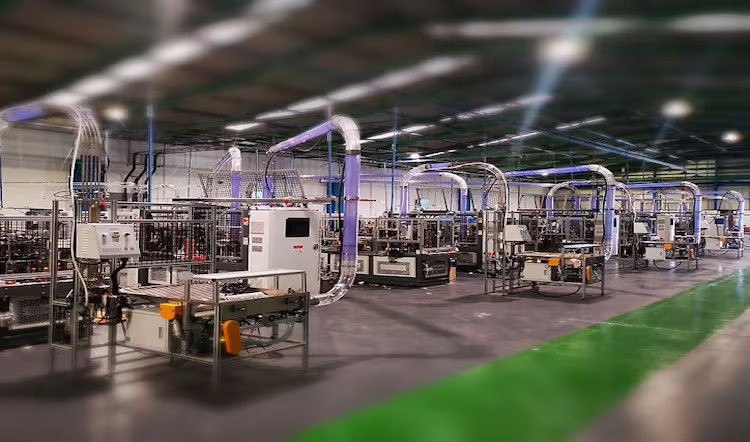
The technology addresses a constraint that has limited paper bottle adoption since the format launched commercially in 2020. Manufacturers struggled to produce enough units to meet demand from major beverage brands. Consequently, paper bottles remained confined to small production runs and premium product lines.
Frugalpac’s new machine changes that commercial reality. The company has already placed units with partners in North America. Monterey Wine Company in California and KinsBrae Packaging in Canada will manufacture bottles close to their filling operations. This distributed model reduces transport distances and associated carbon emissions.
Moreover, the company is negotiating installations in South Africa and France. French wine producers have submitted five formal requests for machines. Global enquiries now cover potential orders exceeding 120 million bottles.
Manufacturing capacity increases while costs fall by 30 percent
The original assembly system could produce 2.5 million bottles annually. That volume proved insufficient for brands wanting to switch substantial portions of their output from glass. The new machine eliminates this bottleneck. A standard three-lane configuration delivers 14 million units per year. Single-lane versions offer 4.5 million bottles for smaller operations.
Furthermore, production costs have dropped substantially. The updated machine cuts manufacturing expenses by 30 percent compared to earlier paper bottle production. This brings the finished product to price parity with labelled glass bottles. In some configurations, paper bottles now cost less than glass equivalents.
Each bottle comprises 94 percent recycled paperboard. The remaining material consists of a food-grade liner and a small plastic cap. The complete package weighs significantly less than glass. Transportation savings compound throughout the supply chain as a result.
Frugalpac works with Siemens to support distributed manufacturing networks. The technology partnership enables consistent quality control across multiple production sites. Operators can monitor output remotely and adjust parameters in real time.
Carbon savings reach 348 grams per bottle compared to glass
Independent lifecycle assessments confirm that each paper bottle saves 348 grams of CO2 equivalent emissions compared to a standard glass wine bottle. Glass production requires high-temperature furnaces running continuously. Recycled paperboard processing demands far less energy. Transport emissions fall because paper bottles weigh less.
To date, Frugalpac’s technology has prevented 746 tonnes of carbon dioxide from entering the atmosphere. The company has also conserved 4.4 million litres of water through reduced manufacturing intensity. These figures cover all bottles produced since commercial launch in 2020.
If new installations operate at projected capacity, annual carbon savings could exceed 4,800 tonnes. That calculation assumes all bottles replace glass equivalents. The environmental benefit scales linearly with adoption rates.
Water usage matters particularly in wine-growing regions facing drought conditions. California, South Africa, and southern France all experience water stress during growing seasons. Switching packaging formats reduces industrial water consumption in these areas.
Wine industry faces mounting pressure to reduce packaging emissions
Glass bottles account for the largest share of carbon emissions in wine production. A study of European wineries found packaging contributed between 29 and 51 percent of total product emissions. Vineyard operations and fermentation produce lower impacts by comparison.
Regulations are tightening across multiple markets. The EU’s Corporate Sustainability Reporting Directive requires large companies to disclose Scope 3 emissions. Packaging falls within this category. UK businesses supplying public sector contracts must demonstrate carbon reduction plans under PPN 06/21.
Meanwhile, consumer research indicates growing preference for sustainable packaging among younger buyers. However, price sensitivity remains high. Brands need packaging solutions that match glass on cost while delivering environmental benefits. The new production technology meets both requirements.
Retailers also exert pressure through procurement policies. Several UK supermarket chains have committed to reducing packaging emissions across their supply base. Wine suppliers face questions about alternatives to heavy glass bottles during category reviews.
Distributed production model reduces supply chain vulnerabilities
Installing assembly machines near filling operations offers practical advantages beyond carbon savings. Glass bottles typically travel long distances from specialized manufacturing plants. Supply chains proved fragile during recent disruptions. Container shortages and freight delays affected beverage producers globally.
Local production shortens lead times and reduces inventory requirements. Bottlers can order smaller quantities more frequently. This flexibility helps manage cash flow and warehouse space. Additionally, currency fluctuations matter less when manufacturing occurs in the same country as filling.
The modular design allows companies to start with single-lane systems and expand capacity later. A business filling four million bottles annually can match production precisely to demand. Larger operations can install multiple machines or upgrade to three-lane configurations.
Quality control improves when production happens on-site. Operators identify issues immediately rather than discovering defects after shipment. This reduces waste and protects brand reputation. Real-time monitoring through Siemens systems provides data for continuous improvement.
Current adoption spans 30 brands across 25 countries
Frugalpac reports that 30 beverage brands now use paper bottles across 100 different products. These reach consumers in 25 countries. Adoption has concentrated in premium wine segments where sustainability messaging supports higher price points.
However, the cost reduction from new manufacturing technology opens mass-market opportunities. Brands selling at mid-tier price points can now consider paper packaging without eroding margins. This expands the addressable market substantially.
The company has installed or committed to exporting more than 100 assembly machines globally. Demand concentrates in established wine regions including France, Spain, Italy, California, Australia, and New Zealand. Each region brings specific regulatory drivers and consumer preferences.
French producers show particular interest despite that country’s strong association with traditional glass bottles. Several major wine houses are evaluating paper formats for specific product lines. South African producers see opportunities in export markets where sustainability credentials influence purchasing decisions.
Key details about the production technology
- The FBAM-2 produces 14 million paper bottles annually in standard configuration, compared to 2.5 million from the previous model.
- Manufacturing costs have fallen 30 percent, bringing paper bottles to price parity with labelled glass bottles.
- Each paper bottle saves 348 grams of CO2 equivalent emissions compared to glass packaging.
- The bottles contain 94 percent recycled paperboard with a food-grade liner and small plastic cap.
- Frugalpac has received enquiries covering potential production of over 120 million bottles globally.
- Current adoption includes 30 brands selling 100 products across 25 countries.
- The technology has prevented 746 tonnes of carbon emissions and conserved 4.4 million litres of water since 2020.
Strategic considerations for UK beverage businesses
Companies evaluating packaging alternatives should examine total cost of ownership rather than unit price alone. Paper bottles weigh less than glass, therefore transport costs fall throughout the distribution chain. Businesses shipping regionally or internationally see compound savings. Storage requires less robust racking because individual units carry lower risk of breakage.
Compliance obligations increasingly favor lower-emission packaging. Our net-zero program for carbon reporting compliance helps businesses quantify packaging impacts within Scope 3 emissions. Manufacturing and transport both contribute to this category. Switching to paper bottles delivers measurable reductions that support reduction targets.
Tender opportunities often include sustainability criteria. Public sector contracts explicitly require carbon reduction plans. Private sector RFPs increasingly evaluate environmental performance alongside price and quality. Documented emission savings from packaging choices strengthen competitive positioning.
Supply chain resilience gained importance during recent disruptions. Distributed manufacturing reduces dependence on single suppliers or long transport routes. Businesses should evaluate whether local production options suit their volume requirements and growth projections. The modular system allows staged investment aligned with demand.
Brand differentiation matters in crowded categories. However, sustainable packaging only adds value if consumers notice and understand the benefits. Marketing materials should explain carbon savings clearly. Shelf presence and pourability need to match glass standards. Early adopters report positive consumer response when communications emphasize tangible environmental improvements.
Working with businesses on sustainable procurement implementation, we observe that successful packaging transitions require cross-functional coordination. Procurement, operations, marketing, and sustainability teams need aligned objectives. Cost savings in one area may require investment in another. Total business case assessment provides clearer decision framework.
Market growth projections indicate expanding opportunity
Industry analysis forecasts the global paper bottles market will grow at 6.8 percent annually through 2030, reaching $2.4 billion in value. This growth reflects both regulatory pressure and consumer preference shifts. Several jurisdictions have implemented or proposed restrictions on single-use plastics. Glass faces no regulatory threats but carries high environmental costs.
Europe leads adoption currently, driven by stringent packaging regulations and strong consumer environmental awareness. However, North American markets are accelerating. California’s climate policies and consumer preferences create favorable conditions. The eastern United States shows growing interest as brands seek differentiation in competitive retail environments.
Asian markets present longer-term opportunities as middle-class consumption grows and environmental awareness rises. Australia and New Zealand demonstrate strong early interest. Their wine industries target export markets where sustainability credentials influence buyer decisions.
Technology improvements continue to expand viable applications. Current systems focus on wine and spirits, but development work addresses other beverage categories. Carbonated drinks present technical challenges that manufacturers are addressing through liner innovations.
Relevant information sources and guidance
The government’s PPN 06/21 guidance on carbon reduction plans explains requirements for suppliers to central government contracts. Packaging emissions fall within Scope 3 reporting obligations.
Businesses requiring support with carbon measurement and reduction planning can access resources through our ESG compliance and carbon reporting services. Understanding packaging impacts forms part of comprehensive emissions accounting.
The UK government’s net zero strategy outlines broader decarbonization commitments affecting business operations. Packaging represents one element within supply chain emissions that companies must address.
Industry body IEMA provides guidance on environmental management including lifecycle assessment methodologies for packaging evaluation. Their resources help businesses compare options objectively.
Frugalpac publishes technical specifications and environmental data at their corporate website. Independent lifecycle assessments verify carbon saving claims. Companies evaluating packaging transitions should request detailed documentation supporting environmental assertions.
Contact Us
We are here to support your net-zero journey, whatever your stage
Our team offers practical guidance and tailored solutions to help your business thrive sustainably.

