
Scopes 1, 2 and 3 Explained - Understanding Emissions for Smarter Sustainability Reporting
n the collective effort to address climate change, businesses play a vital role. Central to this responsibility is understanding and managing greenhouse gas (GHG) emissions. As UK sustainability reporting frameworks evolve, having a solid grasp of emissions categories Scopes 1, 2, and 3 is crucial for any organisation aiming to future-proof operations and build a credible climate strategy.
This post introduces these scopes, explains how they differ, and outlines their significance in sustainability reporting. Whether you’re new to emissions tracking or preparing for upcoming regulatory changes, this guide will lay the groundwork.
Key takeaways:
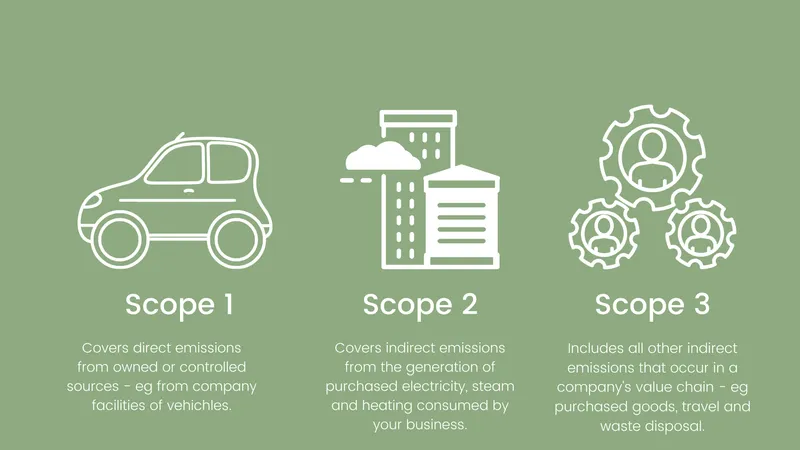
- Scope 1 emissions consist of direct emissions from owned or controlled sources, such as company vehicles and manufacturing processes.
- Scope 2 emissions are indirect and arise from the consumption of purchased electricity, steam, heating, and cooling.
- Scope 3 emissions represent all other indirect emissions occurring in a company’s value chain, often making up the majority of their total emissions.
- Distinguishing between Scopes 1, 2, and 3 is vital for businesses aiming to effectively reduce their overall carbon footprint.
- Transparency and adherence to regulations and standards, such as the Greenhouse Gas Protocol, are increasingly important for corporate responsibility and consumer trust.
Understanding Scope 1 Emissions: Direct from the Source
Scope 1 emissions are direct greenhouse gas emissions from sources that are owned or controlled by a company. This includes:
Fuel combustion from company vehicles
On-site energy production (e.g., natural gas boilers)
Emissions from manufacturing facilities
These emissions are typically the easiest to identify and measure, forming the first layer of a company’s carbon footprint. Despite being more straightforward to manage, Scope 1 often requires significant investment to transition away from fossil-fuel-based infrastructure.
Exploring Scope 2 Emissions: Powering the Business
Scope 2 emissions are indirect, stemming from the generation of purchased electricity, steam, heating, or cooling used by a business. Although the emissions don’t occur onsite, companies are responsible for them because they consume the energy.
For instance, if your office or warehouse runs on electricity generated from coal-fired power plants, those emissions fall under Scope 2.
Switching to renewable energy suppliers or investing in on-site solar power are common ways businesses reduce Scope 2 emissions.
Delving into Scope 3 Emissions: Beyond the Fence Line
Scope 3 is the most complex and wide-reaching. It includes all other indirect emissions that occur across a company’s value chain. These can be:
Upstream: Emissions from suppliers, business travel, and transportation of goods
Downstream: Emissions from product use, end-of-life treatment, and investments
Scope 3 often accounts for the largest share of a company’s emissions, up to 80–90% in some industries. Tracking and managing these emissions is challenging but crucial for a holistic net-zero strategy.
Why Scopes Matter: The Power of Holistic Reporting
Understanding the distinctions between Scopes 1, 2, and 3 allows organisations to:
Identify major emission hotspots
Build data-informed sustainability strategies
Set credible carbon reduction targets
Improve investor and consumer trust
While many UK businesses have already invested in reducing Scope 1 and 2 emissions, Scope 3 remains a frontier with both complexity and opportunity.
The Role of Regulation and Standards in the UK and Beyond
Emissions reporting is increasingly shaped by frameworks like the Greenhouse Gas Protocol, a globally recognised standard for categorising and measuring emissions.
UK businesses can also align with:
ISO 14001 (Environmental Management Systems)
ISO 14064-1 (GHG Inventory and Reporting)
ISO 14068 (Carbon Neutrality)
Together, these standards help businesses build robust environmental strategies and achieve compliance with mandatory and voluntary disclosure frameworks.
Transparency in emissions reporting is no longer optional: it’s a pillar of corporate responsibility and an expectation from stakeholders.
Keywords: regulations, standards, Greenhouse Gas Protocol, corporate responsibility, transparency
Conclusion
Understanding and reporting on Scopes 1, 2, and 3 emissions isn’t just about ticking boxes: it’s a strategic move. With the right knowledge and frameworks, businesses can reduce their environmental impact, meet regulatory demands, and unlock financial benefits through improved efficiency and stakeholder confidence.
In our next post, we’ll explore UK-specific regulatory developments, including the Corporate Sustainability Reporting Directive (CSRD) and how it will affect British businesses.