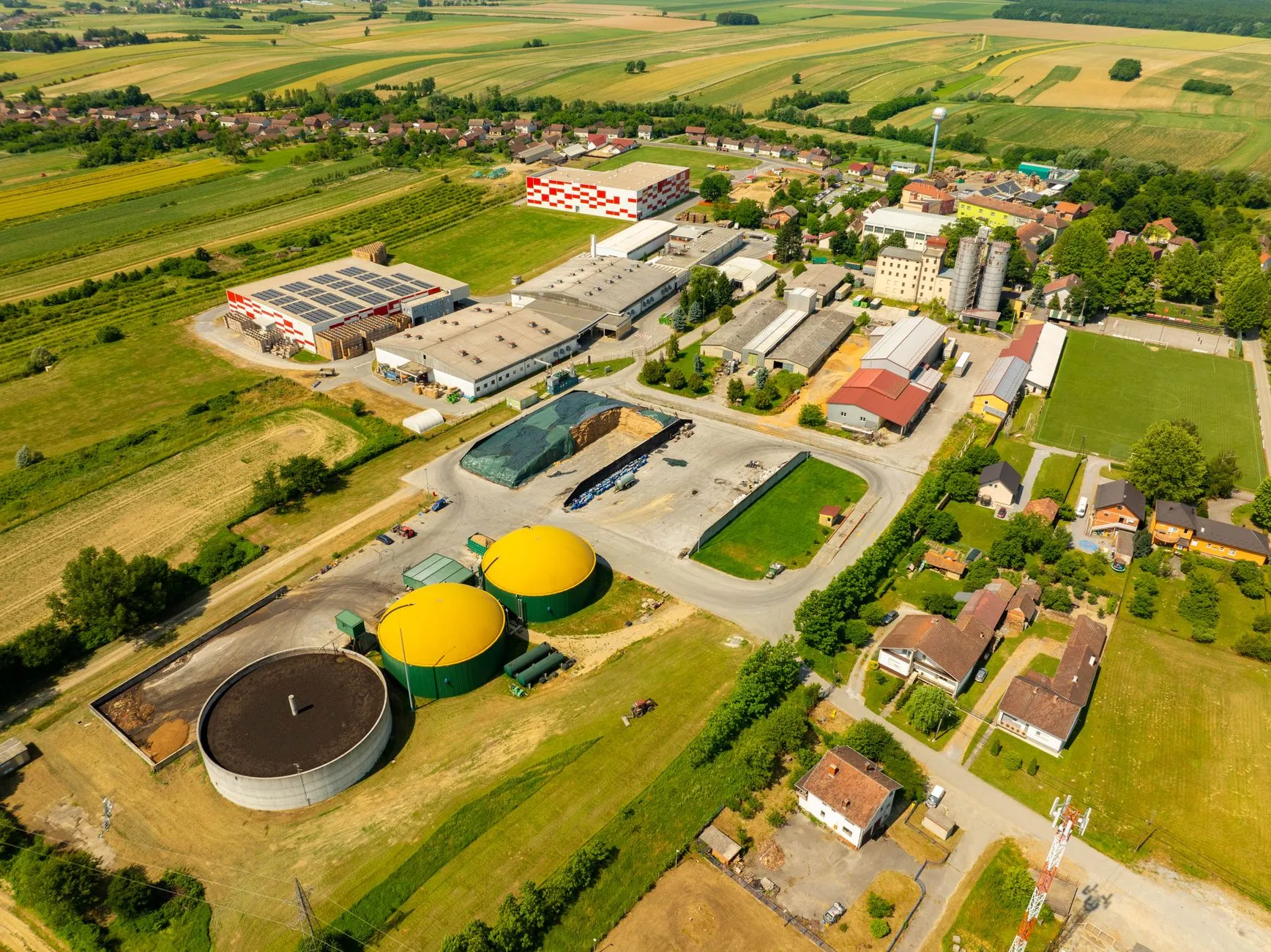
Danone Turns Yogurt Manufacturing Waste Into Biogas at Ohio Facility
<p>A yogurt plant in rural Ohio has begun converting its manufacturing residuals into renewable heat. Danone's facility in Minster now sends wastewater and organic byproducts to an adjacent anaerobic digestion plant, which processes the material and returns biogas to power boilers at the production site. The project represents a shift from treating food waste as a disposal problem to using it as an on-site energy source.</p><p>For food manufacturers, the model addresses two persistent challenges at once. High-strength organic wastewater requires costly treatment before discharge, and process heating accounts for a substantial portion of industrial gas consumption. This facility tackles both by converting waste into thermal energy without requiring long-distance transport or separate disposal arrangements.</p><p>The arrangement also demonstrates how industrial decarbonization can work within existing infrastructure. Rather than replacing boilers or redesigning production lines, Danone is substituting part of its natural gas supply with renewable biogas generated a few hundred metres away.</p><h2>How the Minster facility converts yogurt waste to heat</h2><p>PurposeEnergy designed, financed and operates the new treatment plant in the Route 66 Industrial Park on Columbia Drive. The facility sits adjacent to Danone USA's largest yogurt manufacturing site and processes up to 250,000 gallons of wastewater and organic residuals each day. At full capacity, it is expected to produce approximately 50,000 MMBtu of renewable biogas annually.</p><p>Anaerobic digestion uses microorganisms to break down organic material in sealed tanks without oxygen. The process generates biogas, which consists primarily of methane and carbon dioxide. A pipeline carries the biogas directly to a dedicated boiler at Danone's plant, where it replaces conventional natural gas for process heating. The investment totals more than US$40 million.</p><p>The system also accepts material from other regional food and beverage producers, although Danone remains the anchor customer. Treated water leaves the facility meeting discharge standards set by the Village of Minster, reducing the nutrient load and dissolved solids entering municipal wastewater infrastructure. Residual solids can be used as soil amendments.</p><p>According to PurposeEnergy, the facility is now operational and ramping toward full throughput. A formal grand opening is scheduled for spring 2027. The company describes this as its first partnership with Danone in the United States.</p><h2>Estimated carbon reductions and energy displacement</h2><p>PurposeEnergy estimates the facility could displace approximately 3,200 U.S. tons of carbon dioxide equivalent emissions each year once fully operational. The reduction stems primarily from substituting renewable biogas for fossil natural gas in Danone's boilers. The direct pipeline connection is expected to avoid roughly 720 tons of CO₂ equivalent annually by eliminating the need to transport residuals off-site for disposal.</p><p>These figures are company projections rather than independently verified lifecycle assessments. Actual climate benefits will depend on several factors, including methane capture rates, operating efficiency, the proportion of biogas actually used for heat, and fugitive emissions during handling. Anaerobic digesters can leak methane if not properly sealed and monitored, which matters because methane has a global warming potential roughly 28 times higher than carbon dioxide over a 100-year period.</p><p>Nevertheless, the displacement of natural gas with renewable biogas represents a measurable reduction in fossil fuel consumption. For manufacturers seeking to lower Scope 1 emissions without overhauling production equipment, this type of fuel substitution offers a practical near-term option.</p><h2>Wastewater pre-treatment supports local infrastructure</h2><p>The facility provides a benefit beyond energy recovery. It pre-treats high-strength organic wastewater before discharge, removing nutrients and dissolved solids that would otherwise place additional load on Minster's municipal treatment system. This matters because food manufacturing effluent can contain elevated levels of biochemical oxygen demand, nitrogen and phosphorus, all of which require energy-intensive treatment at municipal plants.</p><p>By treating wastewater at the source, the PurposeEnergy facility reduces the volume and strength of industrial discharge entering the village's infrastructure. This arrangement can extend the capacity of local treatment systems and reduce the energy required for downstream processing. It also gives regional food and beverage manufacturers another route for managing organic residuals that might otherwise require haulage to distant facilities.</p><p>The model is particularly relevant for rural manufacturing sites, where municipal wastewater infrastructure may have limited capacity for high-strength industrial effluent. Consequently, pre-treatment can become a requirement for securing or maintaining operating permits, especially if production volumes are expected to increase.</p><h2>Why food manufacturers are turning to anaerobic digestion</h2><p>Food and beverage production generates organic residuals with significant energy content. However, these materials also create disposal costs, transportation requirements and wastewater challenges. Anaerobic digestion offers a way to address waste management and energy supply in a single process.</p><p>Organic residuals are diverted from landfill or off-site disposal routes. Biogas replaces a portion of fossil fuel consumption, typically for process heat or electricity generation. Treated water reduces pollutant loads entering municipal systems. Nutrient-rich digestate can be used as a soil amendment, provided it meets quality standards and regulatory requirements. On-site or near-site processing reduces waste haulage and associated transport emissions.</p><p>The Minster arrangement is notable because it connects waste source, treatment plant and energy user through dedicated infrastructure. Danone does not need to transport residuals across significant distances or purchase all its process fuel from external suppliers. Instead, organic material moves a short distance to the digester, and renewable thermal energy returns to the plant via pipeline.</p><p>PurposeEnergy's business model reduces the need for manufacturers to develop and operate their own treatment systems. The company builds and runs industrial anaerobic digestion facilities for food and beverage producers, allowing customers to outsource capital expenditure and operational responsibility while retaining access to renewable energy and waste management capacity.</p><h2>Links to Danone's production capacity and sustainability goals</h2><p>The Ohio facility supports Danone's stated objectives around fossil fuel reduction, resource efficiency and circular manufacturing. It also addresses a production constraint. PurposeEnergy has indicated that the treatment system is designed to support Danone's ability to expand yogurt output by providing additional capacity for high-strength organic residuals generated during manufacturing.</p><p>This connection between environmental performance and operational capacity is significant. Waste-to-energy projects are more likely to succeed when they solve a practical business problem alongside a sustainability target. In Minster, the facility helps manage increasing residual volumes, lowers pressure on municipal wastewater systems and supplies renewable heat to the same production line generating the waste.</p><p>For businesses evaluating similar projects, this dual purpose matters. A system that only delivers carbon reductions may struggle to secure internal approval if it requires substantial capital and offers no operational advantage. A system that also resolves a waste-handling bottleneck or reduces disposal costs has a clearer commercial case.</p><p>Our <a href="https://sbs.eco/net-zero-program/">net zero program</a> helps UK manufacturers identify where resource efficiency and carbon reduction align with operational improvements, particularly when assessing energy use and waste streams.</p><h2>What this means for UK food and beverage manufacturers</h2><p>UK food producers face similar challenges with organic waste, energy costs and wastewater discharge. However, the regulatory and commercial context differs from the United States. British manufacturers must comply with Environmental Permitting Regulations for waste treatment and biogas production, and most sites operate under trade effluent consents that set strict limits on wastewater strength and volume.</p><p>Anaerobic digestion is well established in the UK, particularly in agriculture and municipal waste treatment. Nevertheless, on-site industrial digestion remains less common at food manufacturing facilities, often due to space constraints, permitting complexity and the capital required for digester tanks, gas handling and safety systems.</p><p>Third-party operators offering digestion-as-a-service, similar to PurposeEnergy's model, are gradually emerging in Britain. These arrangements can reduce the upfront cost and technical burden for manufacturers, though contracts and offtake agreements require careful commercial and legal review.</p><p>Energy costs in the UK have risen sharply since 2021, making renewable biogas more economically attractive for process heating. Additionally, businesses supplying the public sector must demonstrate carbon reduction progress to meet requirements under Procurement Policy Note 06/21. Replacing natural gas with biogas generated from manufacturing waste can contribute to Scope 1 emissions reductions, which are often harder to achieve than Scope 2 electricity decarbonization.</p><p>For manufacturers considering anaerobic digestion, several factors warrant close attention. Wastewater composition and volume must be assessed to determine whether organic load is sufficient to justify digestion. Available space, proximity to energy demand and access to grid gas infrastructure all influence feasibility. Permitting timelines can be lengthy, particularly for new waste treatment installations. Operational risks include digester downtime, biogas quality variability and the need for skilled maintenance staff.</p><p>Despite these challenges, the Minster project illustrates how integrated waste-to-energy systems can deliver commercial and environmental value when designed around an existing production site. The model works because the waste source, treatment facility and energy user are co-located, reducing transport costs and infrastructure complexity.</p><h2>Key project details for context</h2><ul><li>The facility is located in Minster, Ohio, in the Route 66 Industrial Park and serves Danone USA's largest yogurt manufacturing site.</li><li>Total investment exceeds US$40 million, with PurposeEnergy responsible for design, financing and operation.</li><li>Processing capacity reaches up to 250,000 gallons of wastewater and organic residuals per day at full operation.</li><li>Annual biogas output is projected at approximately 50,000 MMBtu, used for renewable process heat at Danone's adjacent plant.</li><li>Estimated emissions displacement totals roughly 3,200 tons of CO₂ equivalent per year from natural gas substitution, plus approximately 720 tons from reduced off-site transport.</li><li>The facility began operations in 2024 and is ramping toward full capacity, with a public opening event planned for spring 2027.</li><li>Treated water meets Village of Minster discharge standards, reducing nutrient loads entering municipal wastewater infrastructure.</li><li>Residual digestate is processed into nutrient-rich soil amendments for agricultural use.</li></ul><h2>Practical considerations for replicating the model</h2><p>The Minster facility demonstrates that industrial decarbonization does not always require electrification or wholesale process redesign. In sectors where high-temperature or continuous thermal energy remains essential, renewable biogas can provide a practical substitute for natural gas. This is particularly relevant for food manufacturing, where boilers and steam systems underpin much of the production process.</p><p>However, anaerobic digestion is not a universal solution. It requires a consistent supply of suitable organic feedstock, sufficient space for digester infrastructure, and a nearby energy demand that can absorb the biogas output. Projects are most viable when they integrate waste treatment, energy recovery and operational capacity in a single system, as seen in Minster.</p><p>Businesses evaluating similar projects should consider the full operational and regulatory picture. Capital costs for digester tanks, gas handling and safety equipment can be substantial. Permitting for waste treatment and biogas production involves environmental, health and safety authorities. Operational risks include digester microbiology management, biogas quality control and methane leakage prevention. Third-party operators can reduce some of these burdens, though long-term contracts and performance guarantees must be negotiated carefully.</p><p>For UK manufacturers, the commercial case often hinges on energy prices, waste disposal costs and the stringency of trade effluent consents. Rising natural gas prices strengthen the economic argument for biogas substitution. Similarly, tightening discharge limits or capacity constraints at municipal treatment works can make on-site pre-treatment more attractive.</p><p>The Minster project also highlights the importance of co-location. Moving waste a short distance to a dedicated treatment facility, then returning energy via pipeline, minimizes transport emissions and infrastructure costs. This proximity model may not be replicable at every site, particularly in urban or space-constrained locations, but it offers a template for rural or industrial park settings where land is available and multiple facilities can share infrastructure.</p><p>Our <a href="https://sbs.eco/compliance/">compliance services</a> support food and beverage manufacturers in assessing environmental permitting requirements and aligning waste-to-energy projects with carbon reporting obligations.</p><h2>Limitations and broader decarbonization context</h2><p>Anaerobic digestion addresses part of the emissions challenge for food manufacturers, but it is not a complete decarbonization solution. The Minster facility is expected to offset only a portion of the natural gas used at Danone's plant. Full decarbonization of industrial heat remains a more complex challenge, often requiring hydrogen, electrified steam systems or alternative fuels that are not yet widely available at scale.</p><p>The climate benefit of biogas also depends on how well methane is captured and controlled throughout the process. Digesters, pipelines and boilers all present potential leak points. Methane has a significantly higher global warming potential than carbon dioxide over a 20-year horizon, so even small leakage rates can erode emissions savings. Consequently, robust monitoring and maintenance are essential to ensure that projects deliver the intended reductions.</p><p>Soil amendments derived from digestate must meet quality standards and be applied responsibly to avoid nutrient runoff or contamination. Treated water must comply with discharge regulations and not simply transfer pollutant loads downstream. These factors require ongoing oversight and cannot be assumed to work without active management.</p><p>Nevertheless, the Minster facility represents a measurable shift from a linear production model, where food residuals leave the site for disposal and fossil fuel is purchased separately, toward a more circular system in which manufacturing byproducts become inputs for energy and resource recovery. Its performance during full-scale operation will help determine whether similar arrangements can be replicated at other large food and beverage plants.</p><p>For businesses in the UK, the takeaway is that waste-to-energy projects can deliver tangible carbon reductions and operational benefits when designed around existing production systems. However, success depends on careful feasibility assessment, realistic performance expectations and integration with broader decarbonization strategies.</p><p>Training on industrial energy systems and carbon accounting is available through the <a href="https://sbs.eco/sbs-academy/">SBS Academy</a>, which provides practical guidance on evaluating renewable energy options and managing Scope 1 emissions reporting.</p><h2>Where to find further information</h2><p>The <a href="https://www.gov.uk/government/organisations/department-for-energy-security-and-net-zero">Department for Energy Security and Net Zero</a> provides policy guidance on industrial decarbonization and renewable heat. The <a href="https://www.gov.uk/government/organisations/environment-agency">Environment Agency</a> publishes detailed guidance on anaerobic digestion permitting and environmental standards for waste treatment facilities. Trade bodies such as the <a href="https://www.wrap.org.uk/">Waste and Resources Action Programme</a> offer practical resources on circular economy approaches in food manufacturing. Additionally, the <a href="https://www.ofgem.gov.uk/">Office of Gas and Electricity Markets</a> regulates renewable gas injection to the grid and provides information on biomethane support schemes.</p><p>Businesses considering similar projects should consult environmental permit requirements early in the feasibility process. Local planning authorities and environmental health departments can provide site-specific guidance on waste treatment, biogas production and discharge consents. For manufacturers subject to public procurement carbon requirements, our <a href="https://sbs.eco/net-zero-hub/">net zero hub</a> includes resources on demonstrating emissions reductions and aligning project outcomes with PPN 06/21 compliance.</p>