
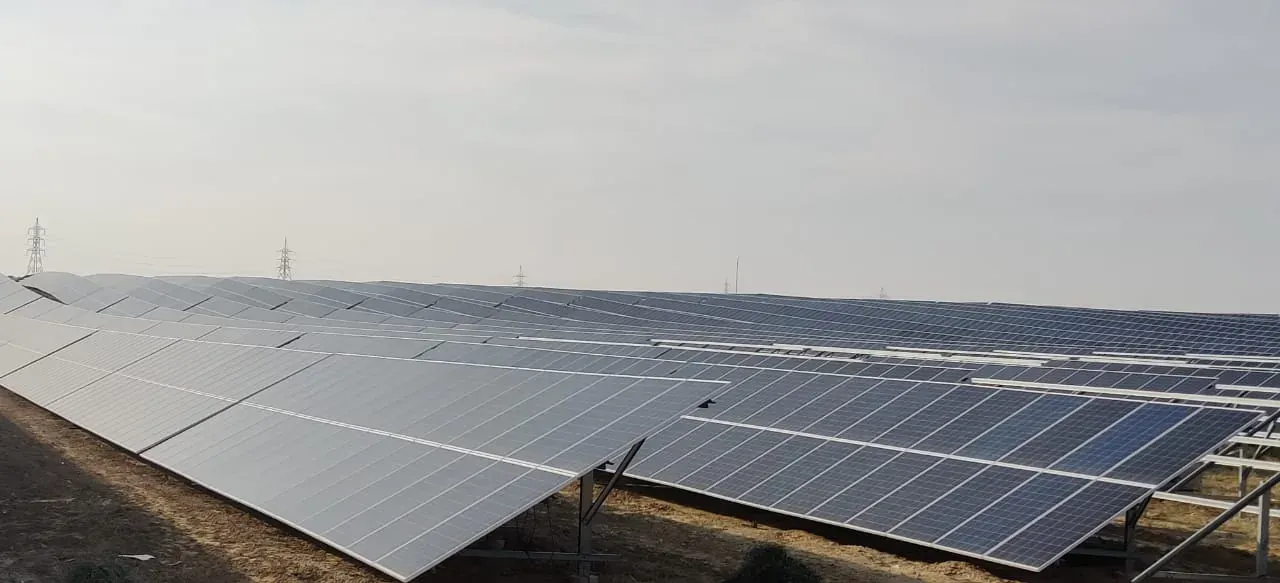
Image: Gold Standard Marketplace project listing
300 MW Solar PV Plant at Bhadla, Rajasthan
A 300 MW solar park in the Thar Desert feeding the Indian grid, displacing electricity that would otherwise come from fossil-fuel-based generation.
About this project
Bhadla sits in the Thar Desert in western Rajasthan. This project is a 300 MW photovoltaic plant at Bhadla, Rajasthan, operated by Clean Solar Power (Bhadla) Pvt. Ltd and connected to the Indian national grid.
India’s grid is still dominated by fossil-fuel-based generation. Every unit of electricity the plant exports displaces a unit that would otherwise have been generated from the fossil-fuel mix, and that displacement is what the Gold Standard credits measure. The plant generates around 900,000 MWh a year and the project is credited for roughly 740,000 MWh of displaced grid electricity, avoiding an estimated 693,000 tCO2e annually.
Why we support it
Sustainable Business Services holds a mixed nature portfolio: UK woodland removal projects such as Jon’s Wood, alongside Gold Standard-verified avoidance projects such as this one. The two kinds of credit make different claims, and a business using both should report each as what it is.
We chose this project for the scale and certainty of its climate effect. A grid-connected solar plant is one of the most straightforwardly measurable sources of avoided emissions there is: the metered export is known, the grid emission factor is published, and the Gold Standard verification checks both.
Impact
Figures below describe the Bhadla plant as a whole, as published on the Gold Standard Marketplace. A client’s own retirement is a purchase of credits from this project, not a share of these totals; the numbers here are the scale of the scheme, not what any one buyer holds.
- Around 693,000 tCO2e avoided a year by displacing fossil-fuel generation on the Indian grid
- Around 740,000 MWh a year of grid electricity displaced, from a plant generating around 900,000 MWh
- 300 MW of installed capacity at Bhadla, Rajasthan
- 42 people employed at the plant during the most recent monitoring period, with six training sessions to build capacity
Sustainable Development Goals
SDG 7: Affordable and Clean Energy. The plant adds 300 MW of solar capacity to a grid still dominated by fossil-fuel-based generation.
SDG 8: Decent Work and Economic Growth. The plant employs 42 people and has run six training sessions to build capacity.
SDG 13: Climate Action. Each megawatt-hour exported displaces a megawatt-hour of fossil-fuel generation, avoiding an estimated 693,000 tCO2e a year.
Verification
The 300 MW Solar PV Plant at Bhadla is certified under the Gold Standard as project GS7726, with independent, third-party verification of the electricity exported and the emissions it displaces.
This is an avoidance project, not a removal project: it stops emissions that would otherwise have occurred, rather than extracting existing CO2 from the atmosphere. Businesses reporting against both this project and a UK removal scheme should describe each accurately in their own reporting, since the two make different claims.